
You are hereCorruption preventive tools
Corruption preventive tools
Prevention Division, ACC.
Corruption preventive tools towards GNH
In undertaking its mandate to prevent and curb corruption in the Kingdom, ACC has adapted several corruption preventive tools. The tools range from corruption risk assessment, public service improvement mechanisms through ensuring public trust and confidence in the government institutions and its officials. Diverse approaches are being adopted in collaboration with relevant agencies and willing partners to gradually make ‘corruption prevention’ a Bhutanese organizational culture. ACC is optimistic that with the constant political will and support and; ACC’s own proven zeal, all these international tools can be operationalized by Ministries and agencies.
- Integrity Pact
Integrity Pact (IP) is a tool advocated by Transparency International (TI). It is aimed at preventing corruption in public contracting by drawing agreement between a government (at national or local level) and bidders. It contains rights and obligations to the effect that neither side will: pay, offer, demand or accept bribes; collude with competitors to obtain the contract; or engage in such abuses while carrying out the contract. More importantly, it ensures level playing field that bidders know that they all are bound by the same rules including the concerned government officials. Governments and government officials also have the assurance of a clear framework that protects them from dubious offers.
Such good practice can be institutionalized and implemented only through incorporation in policy documents such as procurement rules. Following the proposal of ACC, the Ministry of Finance has incorporated IP as a key component of tender document. Unlike the tradition of monitoring the contractors of any unethical conducts, the Pact equally monitors the conduct and performance of government client officials.
Some of the hydro power projects, including Chuka Hydro Power project and Punatsangchu have already introduced IP as a mandatory part of the tender process. Limiting the technical bid evaluation to qualification criterion of the bidder is one major reform followed by the introduction of Integrity Pact.
Concerned agencies and ACC need to intensify and diversify public education and advocacy programs, dissemination of information and capacity building.
- Asset Declaration
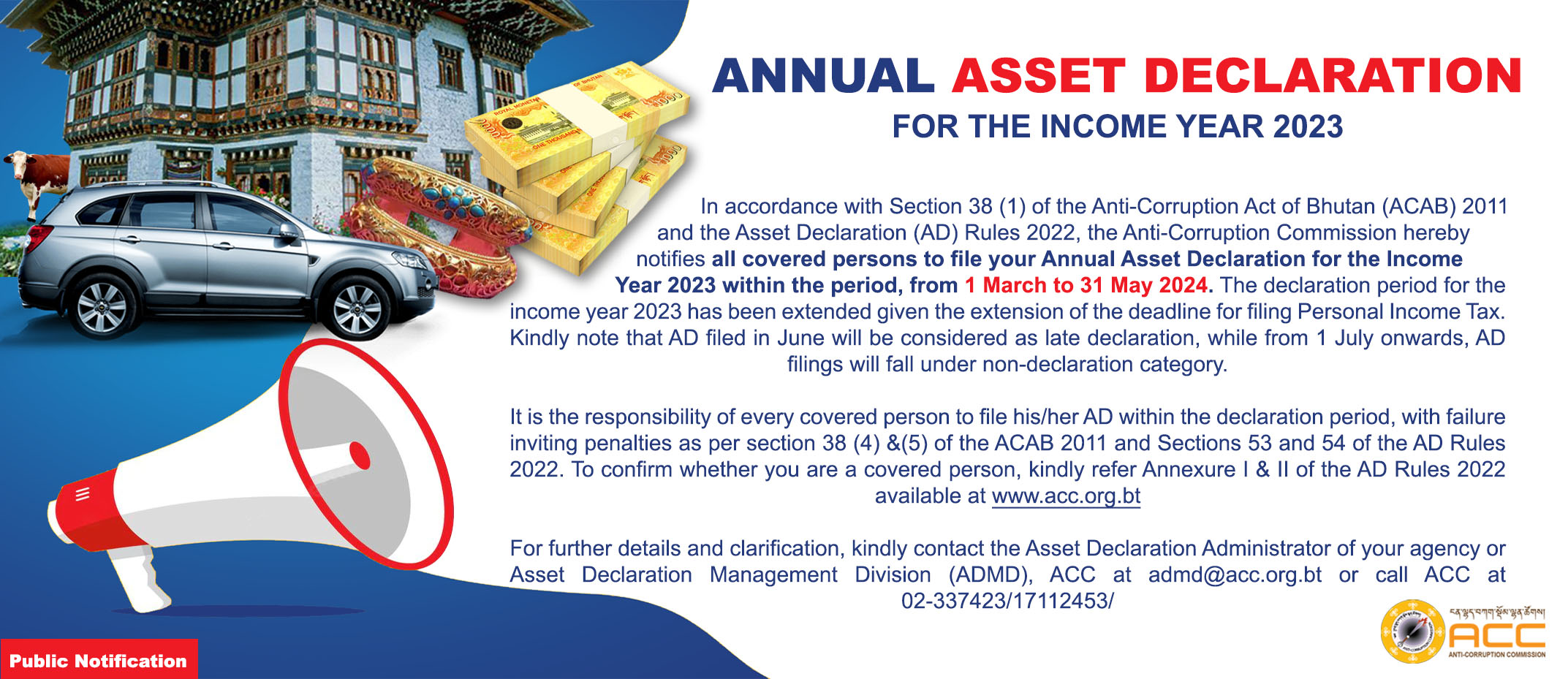
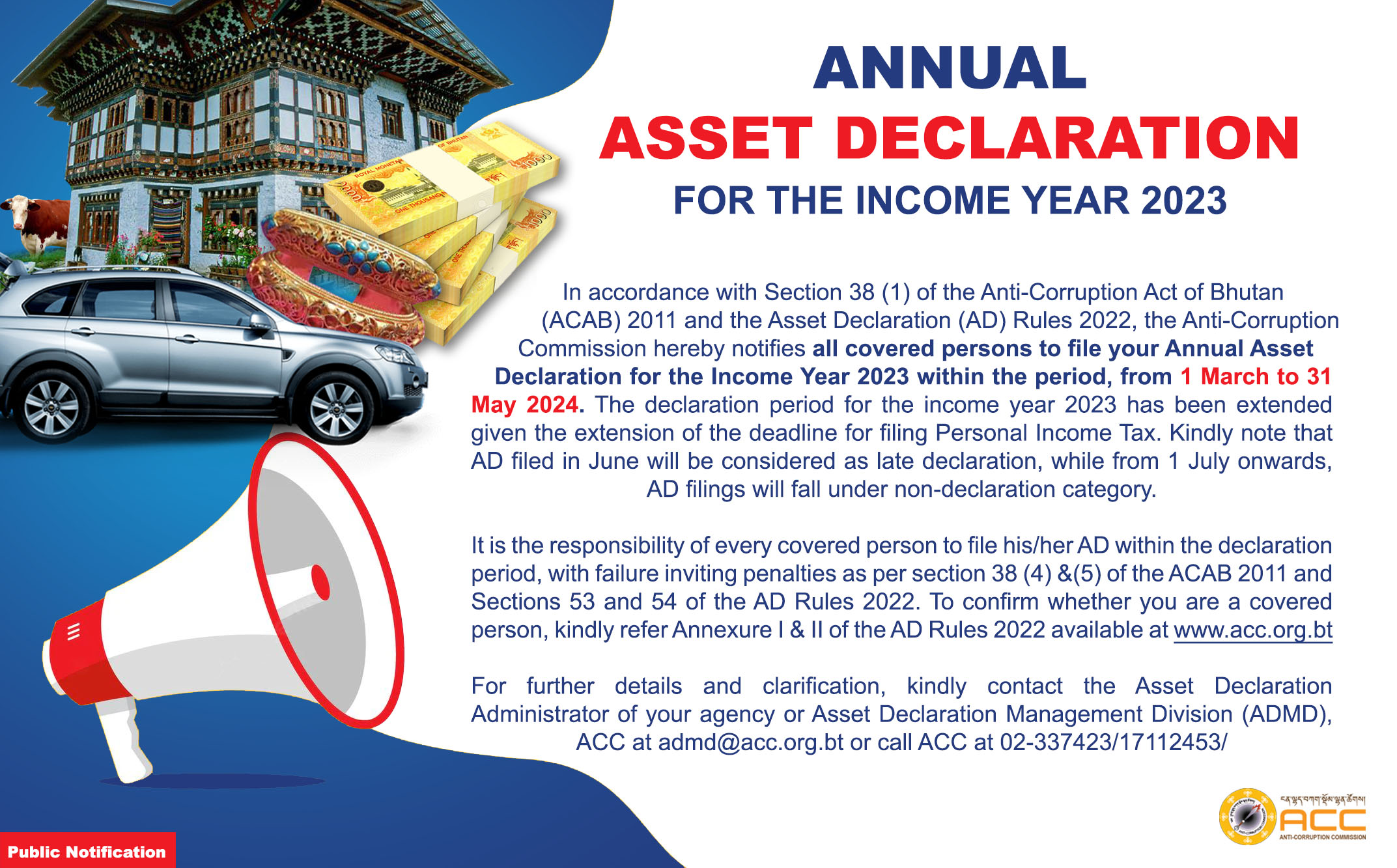
Declaration of asset and liability is an important tool to enhance transparency and accountability of public employees as custodians of public resources to the general public. Besides, it also helps disclose financial interests and, therefore, helps prevent accumulation of disproportionate wealth. It is also a requirement as per BCSR 2006. ACC in collaboration with the RCSC in 2008 has refined and finalised the rules after the RCSC decided to follow one rule on asset declaration.
In accordance with the Asset Declaration rule, the responsibility to administer and manage asset declaration system lies with the heads of respective agencies. Furthermore, the responsibility to audit and conduct investigations pertaining AD has also been decentralized to RAA and RCSC for certain categories of public servants. The syetm needs to be fully operationalised and owned by respective Ministries and agencies.
- Standard Cost Model to reduce Administrative Burden (AB)
Any unnecessary requirement in a regulation is termed as Administrative Burden. The government is aware of the administrative burden and is making efforts to reduce it and simplify official procedures. After the two years of constant vigor and collaboration to promote the concept of AB, ACC has managed to gain the Government’s confidence through the Task Force of Standard Cost Model (SCM). SCM is a method for determining administrative burden for businesses imposed by regulation. It is a quantitative methodology that can be applied at different levels in any country. When contradictory, unclear and excessive rules and procedures exist in the system, they negate service delivery and burden the public, breeds corruption thus hindering the economic growth. The tool is, now going to be applied in all Ministries and agencies through the Improvement of Public Service Delivery System (IPSDS), which ACC is a part of. Led by IPSDS office all Ministries and agencies have reviewed their respective services and are developing service delivery standards as part of service delivery improvement measures.
- Service Standards
Efficiency of services cannot be gauged without a service standard. It also ensures transparency and accountability of service providers. It is important for all clients to understand and fulfill their obligations. Not many organizations have initiated the development of service standards though ACC had floated the idea since 2007. The service standards developed by few organizations in collaboration with ACC, needs to be strengthened. Being a baseline for gauging service efficiency, this tool is inevitable irrespective of its slow progress. Lately, all Ministries and agencies are developing service (delivery) standards under the support and guidance of IPSDS office, RCSC.
- Conflict of Interest
The Organisation for Economic Cooperation and Development (OECD) has undertaken extensive work on conflicts of interest and has developed the following simple and practical definition:
A ‘conflict of interest’ involves a conflict between the public duty and private interests of a public official, in which the public official has private interests which could improperly influence the performance of their official duties and responsibilities.
A conflict of interest can arise from avoiding personal losses as well as gaining personal advantage – whether financial or otherwise.
Conflicts of interest can be actual, perceived or potential.
• An actual conflict of interest involves a direct conflict between a public official’s current duties and responsibilities and existing private interests.
• A perceived or apparent conflict of interest can exist where it could be perceived, or appears, that a public official’s private interests could improperly influence the performance of their duties – whether or not this is in fact the case.
• A potential conflict of interest arises where a public official has private interests that could conflict with their official duties in the future.
Understanding and defining the differences between actual, perceived or apparent and potential conflicts of interest assists in identifying when a conflict exists and determining which type of management approach may be the most appropriate.
It is important to recognize that a poorly-managed perceived or apparent conflict of interest can be just as damaging as a poorly-managed actual conflict of interest. The critical factor is that public officials must not only behave ethically, they must also be seen to behave ethically.
Many internal auditors, including some corporations, through the tripartite (RAA, Internal Audits and ACC) coordinatinon meeting forum have introduced declaration of conflict of interest system.
Sample form to declare conflict of interest:
DECLARATION OF CONFLICT OF INTERESTS
(Sample)
Name of the Committee member/Committee___________________________________
Subject: ________________________________________________________________
Date: __________
Financial Interest: _________________________________________________________________
Close Personal Relationship:
__________________________________________________________________
Other Potential Conflicts of Interest/Enmity:
__________________________________________________________________
I hereby declare that the above details are correct to the best of my knowledge and I make this conflict of interest declaration in good faith.
-Signature (Employee)
Date:_______
(To be filled by Chairperson of the Committee)
I hereby declare that I have received and appropriately noted this conflict of interest to be:
(Additional remarks) e.g whether or not to let the individual participate in the official dealing after noting the conflict)
Signature (Chairperson)
Date:_______
Brief descriptions of the types of conflict of interest
Financial/Pecuniary interests
Money does not need to change hands for an interest to be pecuniary/financial. People have a pecuniary/financial interest if they (or a relative or other close associate) own property, hold shares, have a position in a company bidding for government work, or receive benefits (such as concessions, discounts, gifts or hospitality) from a particular source. Or when there was actual exchange of cash in the form of loan or lending of money between the two parties.
Close Personal Relationship:
Close personal relationship should include anyone who is related through blood.
Other Personal relationship:
Other personal relationship should include everyone who enjoys intimate relationship like family doctors, lawyers, and close friends.
Enmity
Conflict of Interest not only occurs in the form of good relations, it can equally or more seriously occur in the situation of enmity.
Conflicts of interest can be actual, perceived or potential.
• An actual conflict of interest involves a direct conflict between a public official’s current duties and responsibilities and existing private interests.
• A perceived or apparent conflict of interest can exist where it could be perceived, or appears, that a public official’s private interests could improperly influence the performance of their duties – whether or not this is in fact the case.
• A potential conflict of interest arises where a public official has private interests that could conflict with their official duties in the future.
- Code of Ethics
Strong moral and ethical values are critical factors to ensure and sustain organizational credibility and efficiency and to earn higher level of public trust and confidence. While many government and public organizations have code of ethics, mechanisms for their implementation and compliance monitoring do not exist.
As an expample, ACC had consensually developed its Ethical Code of Conduct that was launched on July 11, 2008 during which all ACC staff pledged to follow it in letter and spirit. The Ethical Code of Conduct is regarded as a fundamental step in building corruption resistance and professionalism. The ACC’s Code clearly defines the responsibilities of the management and employees and most importantly an ethics committee has been established to oversee its implementation with clear process for monitoring, reporting, penalizing and appealing. Though ACC extended its support to develope and operationalise for other Ministries and agencies, only few asked for copies of it.
- Corruption Risk Management
Corruption Risk Management (CRM) is a simple in-house tool (Korean Model) to deal with corruption risk in an organization. By using this tool, organizations not only can identify and assess corruption risks and their causes, but also help bring about potential treatment strategies to prevent each corruption risk in a proactive way. This tool can also help agencies bring about institutional improvements by identifying loop holes in the systems with respect to infrastructure, institutions, society and culture. The tool entailing six basic steps can be adapted and used by any organization.
The following are the six basic steps to guide through a process of identifying specific corruption risks and their management process:
Fig 1: Corruption Risk Management tool
Organizational Health Check
There are also tools in the form of simple check list to assess whether or not fraud and corruption prevention system exists in the organization. Such an assessment tool also can be developed based on the vulnerabilities of the organizations. The first and the foremost thing for an organization to understand is its vulnerabilities. A sample of Risk Assessment format adapted from Crime and Misconduct Commission (CMC), Australia us as follows:
Fig-2: Risk assessment worksheet
|
IDENTIFICATION |
ANALYSIS |
EVALUATION |
RISK TREATMENT |
|||
|
Area being assessed |
Specific risks |
Risk degree |
Current controls or mitigating factors |
Control improvements |
||
|
Liklihood |
Consequence |
Risk rating |
|
|
||
|
|
|
|
|
|
|
|
Liklihood Consequences Risk Exposure
A=Almost certain I=Insignificant VH=Very high risk-immediate action required
B=Likely II=Minor H=High risk-senior management attention required
C=Moderate III=Moderate M=Medium risk-management responsibility must
D=Unlikely IV=Major be specified
E=Rare V=Extreme L=Low risk-Manage by routine procedures
- Integrity Assessment survey
Integrity means earning and sustaining the public trust by:
-Serving the public interest
-Using powers responsibly
-Acting with honesty and transparency
-Preventing and addressing improper conduct
Integrity assessment is a systematic approach of fighting corruption. This was first designed by Anti-Corruption and Civil Rights Commission (ACRC) of South Korea to encourage public organizations to make voluntary efforts against corruption by removing corruption factors from their regulations and laws. Integrity here refers to the degree in which civil/public servants of an administrative institution discharge their public duties in a fair and transparent manner as well as in compliance with the laws, rules and regulations without getting involved in misconduct and corruption.
The Anti-Corruption Commission has adopted and launched an Integrity Assessment survey as a systematic approach of preventing corruption. The study which has been outsourced to the National Statistcal Bureau (NSB) includes 24 organizations and will be completed by December 2009. The study will generate national Integrity Perception Index (IPI). It can also generate sectoral Integrity Perception Indices.