
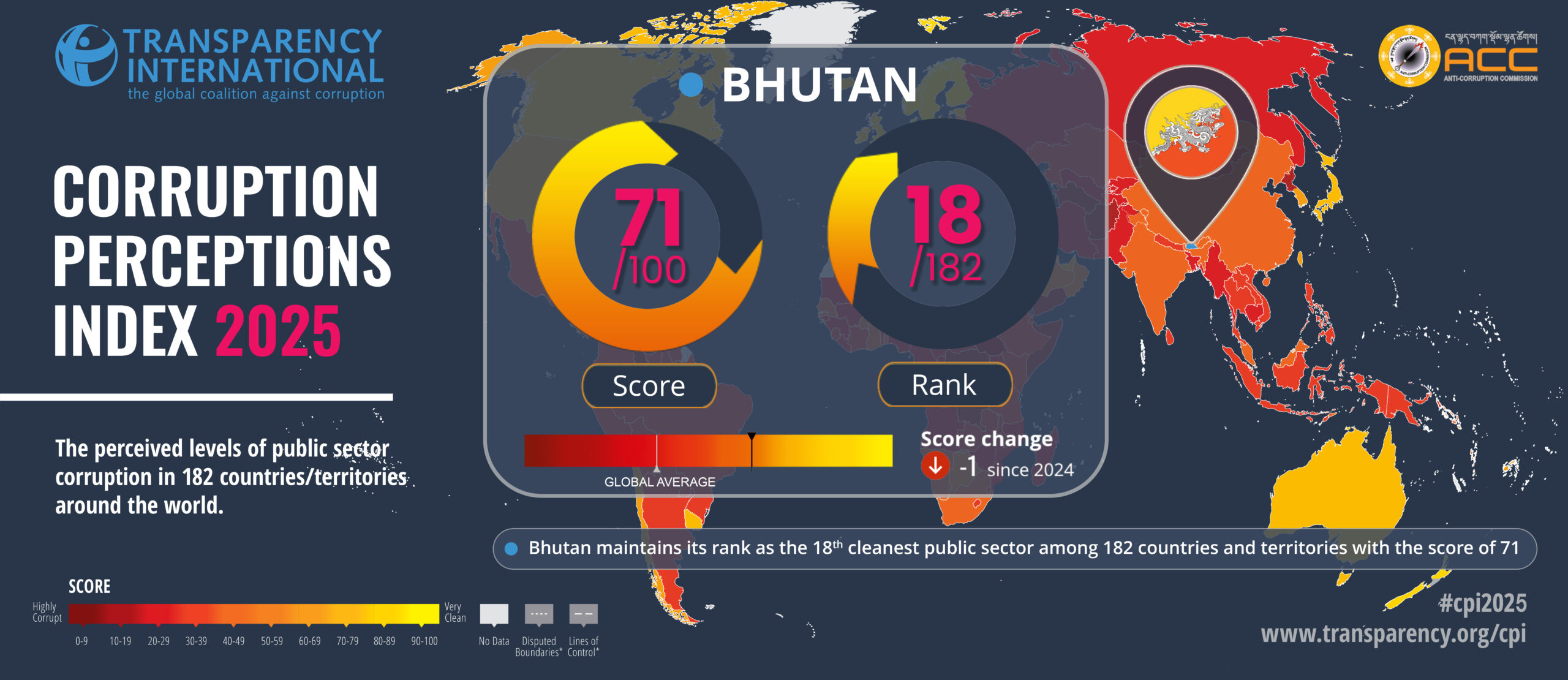
Transparency International (TI) today released the Corruption Perceptions Index (CPI) 2025, which assesses and ranks 182 countries and territories based on perceived levels of corruption in the public sector. The CPI is a composite index derived from multiple independent expert assessments and business surveys conducted by reputable international institutions. Scores range from 0 (highly corrupt) to 100 (very clean).
According to the CPI 2025, Bhutan is ranked 18th globally with a score of 71, reaffirming the country’s position among the stronger performers internationally and its continued leadership within the region.
The CPI 2025 global findings reveal that corruption remains a significant challenge worldwide, with the global average score declining to 42 and more than two-thirds of countries scoring below 50. The shrinking group of high performing countries highlights the growing difficulty of sustaining integrity gains amid increasing economic, regulatory, and governance complexity.
Bhutan’s CPI performance reflects longstanding investments in integrity institutions, rule of law, and accountability frameworks, supported by a consistent national commitment to ethical governance. The result is underpinned by assessments from four CPI data sources viz. the World Bank’s Country Policy and Institutional Assessment (CPIA), Global Insight Country Risk Ratings, Bertelsmann Transformation Index (BTI), and the Varieties of Democracy (V-Dem) Project, each examining governance integrity from complementary perspectives.
The marginal decline from 72 in CPI 2024 to 71 in CPI 2025 is primarily linked to a further decline in Bhutan’s democracy related score under the V-Dem Project, from 66 to 64. This movement reflects heightened perception sensitivity in areas where public authority is exercised through judgement, including judicial decision-making, consistency in administrative actions, and transparency in frontline public service delivery, rather than an increase in bribery, embezzlement, or systemic corruption.
The CPI 2025 signals that for countries operating at higher levels of governance maturity, further improvements increasingly depend not on the creation of new institutions or laws, but on how consistently, transparently, and predictably authority is exercised in practice. This message is particularly salient as Bhutan advances the Diamond Strategy and prepares for the governance demands associated with transformative national initiatives such as the Gelephu Mindfulness City, which will require exceptionally high standards of integrity, regulatory clarity, and institutional coordination.
In this context, Bhutan is entering a more advanced phase of its anti-corruption journey – one that places greater emphasis on integrity outcomes over institutional form, proactive prevention over reactive enforcement, and consistent targeted risk-based interventions over broad policy expansion. Sustaining progress will require whole-of-government ownership of integrity outcomes, strengthened inter-agency coordination, technology enabled data-driven risk analysis, and adaptive strategies capable of addressing emerging corruption risks linked to economic complexity, private sector growth, and large-scale investments.
The Anti-Corruption Commission (ACC) acknowledges that Bhutan’s CPI performance has been shaped by the consistent tone from the top set by His Majesty The King, the sustained political will of successive governments, and the collective efforts of public institutions, civil society, the private sector, and citizens in upholding the values of integrity, transparency, and accountability.
As Bhutan advances toward its long-term national aspiration of achieving Developed Bhutan status, the ACC reaffirms its steadfast commitment to spearheading preventive, intelligence-led, and system-wide anti-corruption interventions, and calls for continued collective responsibility in safeguarding public trust and ensuring that Bhutan’s transformational vision is built on a foundation of integrity and good governance.